

Introduction
In today’s digital world, we generate and share huge amounts of written information every second through emails, social media posts, reviews, articles, and messages. Making sense of all this text manually is almost impossible, which is where text analysis comes in. It is the process of examining written data to understand patterns, meanings, and useful insights in a structured way.
The text analysis definition can be understood as the method of converting unorganized text into meaningful information that can be used for decision making, research, or automation. It helps turn raw language into something that computers and humans can easily interpret.
This concept has become increasingly important in modern times because businesses, researchers, and technology systems rely heavily on data driven insights. Whether it is understanding customer feedback, improving search engines, or training artificial intelligence systems, text analysis plays a major role. Its growing use in AI, business intelligence, and academic research shows how essential it has become in shaping smarter and more efficient digital solutions.
What is Text Analysis Definition
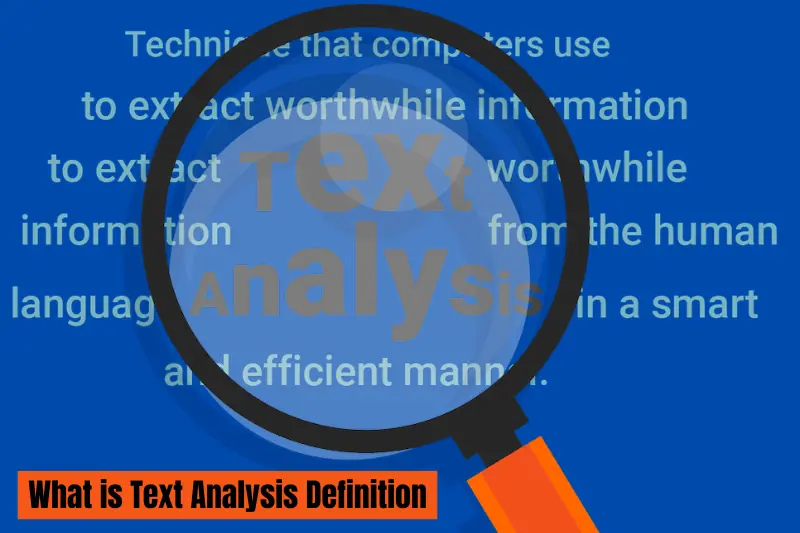
Text analysis refers to the process of examining written content to extract meaningful information, patterns, and insights. It is widely used to convert unstructured text into structured data that can be analyzed further.
In simple terms, text analysis helps computers understand human language. It breaks down sentences, identifies important words, and determines the overall meaning behind the text.
This process is a key part of natural language processing and data science, where the goal is to make sense of large volumes of textual data in an efficient and automated way.
How Text Analysis Works
Text analysis follows a step by step process to transform raw text into useful insights:
First, text data is collected from sources such as websites, social media platforms, or documents. Then the data is cleaned by removing unnecessary symbols, stop words, and irrelevant content.
Next, the cleaned text is processed using algorithms or artificial intelligence models. These systems analyze sentence structure, word frequency, and context.
Finally, meaningful insights are extracted. These insights can include trends, sentiments, categories, or summaries depending on the purpose of the analysis.
Types of Text Analysis
Sentiment Analysis
This type focuses on understanding emotions in text. It helps identify whether the content is positive, negative, or neutral.
Keyword Extraction
This process identifies the most important words or phrases in a text, helping to understand the main topic.
Topic Classification
Text is grouped into different categories based on its content, making it easier to organize large datasets.
Text Summarization
Long pieces of text are shortened into key points while preserving the main meaning.
Importance of Text Analysis in the Modern World
Text analysis plays a crucial role in many industries today. Businesses use it to understand customer opinions and improve products or services. Researchers use it to study large sets of written data efficiently.
In the digital world, it is also essential for monitoring social media trends, improving search engine results, and enhancing user experience on online platforms. Artificial intelligence systems rely heavily on text analysis to understand and respond to human language accurately.
Real World Applications of Text Analysis
Text analysis is used in many practical areas of life.
In marketing, it helps companies understand customer feedback and improve advertising strategies. In healthcare, it assists in analyzing patient records and medical research papers.
Financial institutions use it to detect risks and analyze market trends. Search engines rely on it to deliver relevant results, while chatbots use it to communicate effectively with users.
Tools and Technologies Used in Text Analysis
Modern text analysis relies on advanced technologies such as artificial intelligence and machine learning. Natural language processing techniques help systems understand human language more effectively.
Popular programming tools like Python libraries are widely used to build text analysis models. These tools help process large volumes of text quickly and accurately.
Challenges in Text Analysis
Despite its advantages, text analysis has some challenges. Understanding context, sarcasm, and complex language structures can be difficult for machines.
Handling multiple languages and dialects also adds complexity. In addition, data privacy concerns and model accuracy are important issues that need continuous improvement.
Future of Text Analysis
The future of text analysis looks very promising. With the advancement of artificial intelligence, systems are becoming more accurate in understanding human language.
We can expect faster processing, better contextual understanding, and wider applications across industries. It will continue to play a major role in automation, business intelligence, and digital communication.
Conclusion
Text analysis is a powerful technique that helps transform raw written data into meaningful insights. The text analysis definition highlights its role in converting unstructured text into structured and useful information.
As technology continues to evolve, text analysis will become even more important in shaping how humans and machines interact with data in everyday life.
